Emotional Jujitsu
A practical framework for tactical empathy, non-linear negotiation, and disarming aggressive conflict without meeting force with force.

"When someone pushes you, the instinctive reaction is to push back. But resistance needs a surface to push against. If you step out of the way, their own momentum does the work for you."
The fastest way to lose a high-stakes conversation is to focus entirely on being right.
When your position is uncertain, you are naturally careful. You listen closely, watch your tone, and look for common ground.
When you know for a fact that the other person is wrong, however, patience evaporates. You pull out receipts, cite timestamps, and lay out an airtight case to prove your point.
No one in the history of human conflict has ever responded to that by saying, "Thank you so much for pointing out my ignorance. I completely agree with you now."
Instead, their jaw tightens, their eyes glaze over, and they dig in their heels. The conversation stops being an exchange of useful information and becomes a battle over personal pride. You might leave the room holding all the correct facts, but the deal falls apart, a colleague holds a grudge, or a project grinds to a halt.
I learned this the hard way after moving abroad and navigating high-pressure negotiations where I had zero institutional leverage. Battering someone with raw logic threatens their pride, and threatened people stop listening.
To resolve real tension, you need a different mental model. The physical mechanics of Brazilian Jiu-Jitsu offer one of the best frameworks available.
The philosophy of the mat
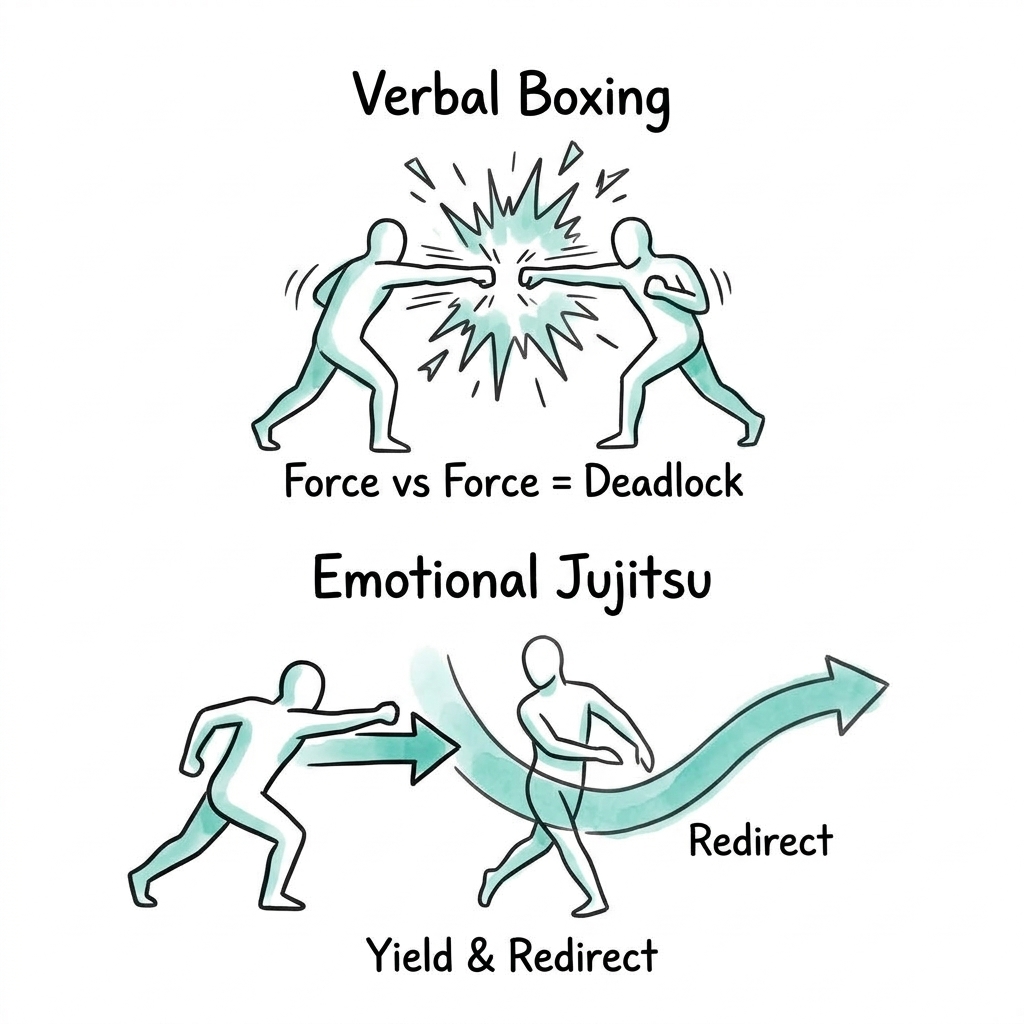
In striking sports like boxing, fighters rely on direct collisions of force. You throw a punch, and the other person blocks it. They strike back, and you absorb the hit. The advantage almost always goes to whoever is larger, louder, or physically heavier.
Most verbal arguments operate on the exact same boxing logic. Two people trade verbal blows, getting louder and more stubborn until one of them wears down or walks out of the room furious.
Jiu-Jitsu was designed around an entirely different problem. It teaches a smaller, lighter person how to control an opponent who is bigger, louder, and more aggressive.
The fundamental rule of the mat is never to meet force head-on.
When an opponent lunges forward with all their weight, planting your feet and bracing for impact is the worst thing you can do. You absorb the full force of their momentum. But if you yield and step off the line of attack, you take the energy they created, disrupt their balance, and let their own weight carry them into open air.
The same physics apply to human conflict.
When someone attacks you with blame, anger, or an unreasonable demand, their emotional momentum is high. If you put up a wall of counter-arguments, you give them a solid wall to smash against.
Resistance needs friction to survive. When you refuse to be that surface, their aggression hits an empty room. And once they lose their footing, you can guide the conversation on constructive terms.
Stepping off the line of attack
Before you can resolve anything, you have to face an uncomfortable reality. You cannot reason with someone whose fight-or-flight response is running the show.
When someone attacks you verbally, their brain perceives an immediate threat. In that state, pulling out a spreadsheet or pointing out a flaw in their logic feels like an attack back. It never registers as helpful clarification.
Your first move in emotional jujitsu is to step off the line of attack. You do not defend yourself, you do not make excuses, and you never tell them to calm down.
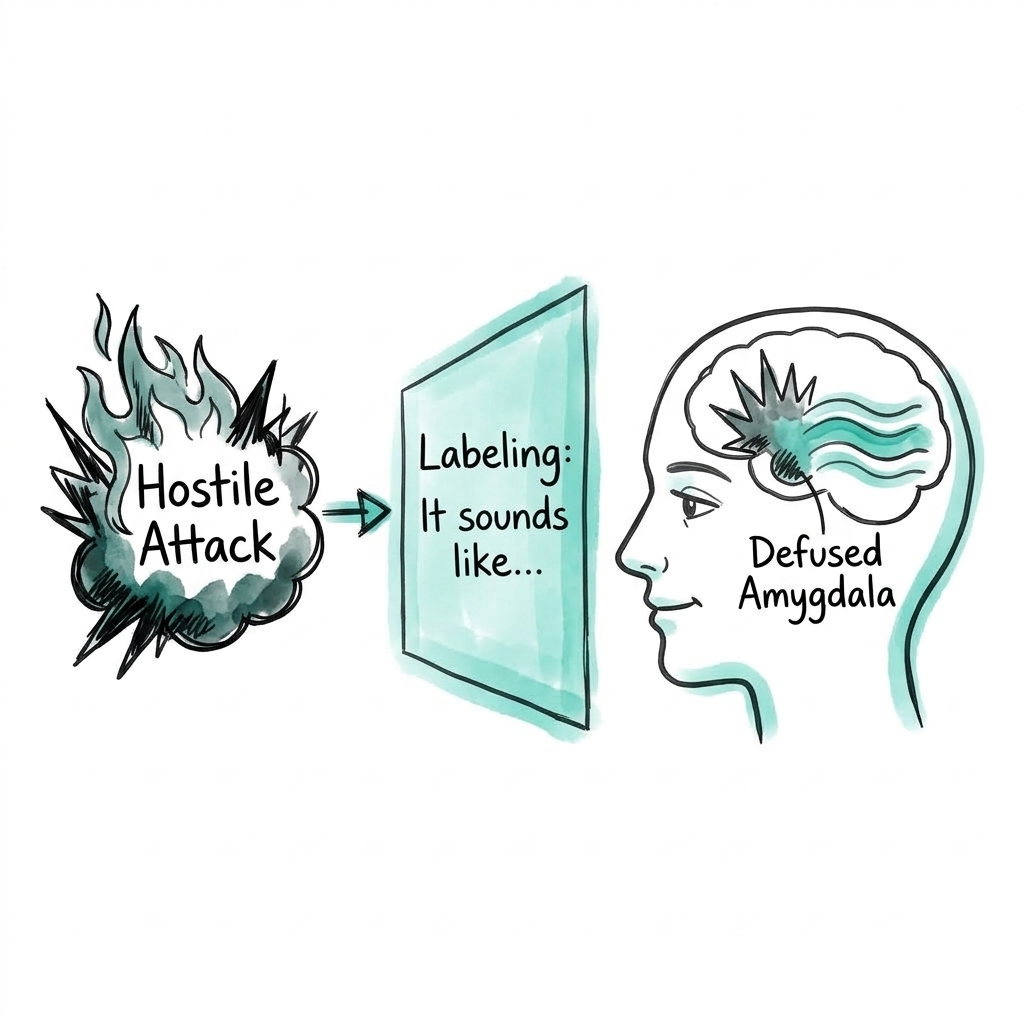
Instead, you absorb the tension by naming what they are experiencing.
Labeling the unspoken pressure
When someone launches an aggressive accusation, they brace for an immediate collision. When they encounter steady, neutral curiosity instead, their defensive posture begins to slip.
The fastest way to drain hostility from a room is to look past the aggressive wording and name the underlying pressure. You can say something like, "It sounds like you are worried this delay will make you look bad to leadership." Or, "It seems like you feel your time on this project was completely disregarded."
Avoid saying, "I understand how you feel," which sounds patronizing and invites an angry denial. Describe the room's emotional temperature directly.
When someone hears you describe their frustration accurately, their biological urge to fight drops. Their shoulders relax, their breathing slows, and their tone softens. You have not agreed to their demands; you have simply removed their reason to shout.
Mirroring and the weight of silence
If someone throws a sweeping accusation at you, claiming that your entire team is impossible to work with, your immediate instinct is to list five examples of how hard everyone worked.
Resist that urge. Meeting an exaggerated claim with defensive proof only starts an argument over whose memory is better.
Instead, repeat the last two or three words of their accusation with a calm, curious inflection, then stay quiet.
Ask, "Impossible to work with?" and wait.
Most people are deeply uncomfortable with silence. Because your question sounds genuinely curious, the other person will rush to fill the quiet room.
Almost every time, they will walk back the broad exaggeration and hand you the specific problem beneath it. They might admit that the whole team isn't the problem, but Sarah missed a Tuesday deadline, and it ruined their morning presentation.
The fog clears immediately. You are no longer defending your team against a sweeping insult. You are just discussing a missed deadline on Tuesday.
Shifting from demands to underlying problems
When people get angry, they lock themselves into fixed positions. One person insists a project must launch on Monday, while the other declares that launching on Monday is suicidal.
When both sides push directly against each other, the result is either an exhausting gridlock or a resentful compromise where everyone walks away unhappy.
Negotiation researchers call this the trap of surface positions. A position is what someone says they want. An interest is the underlying problem they are trying to solve.
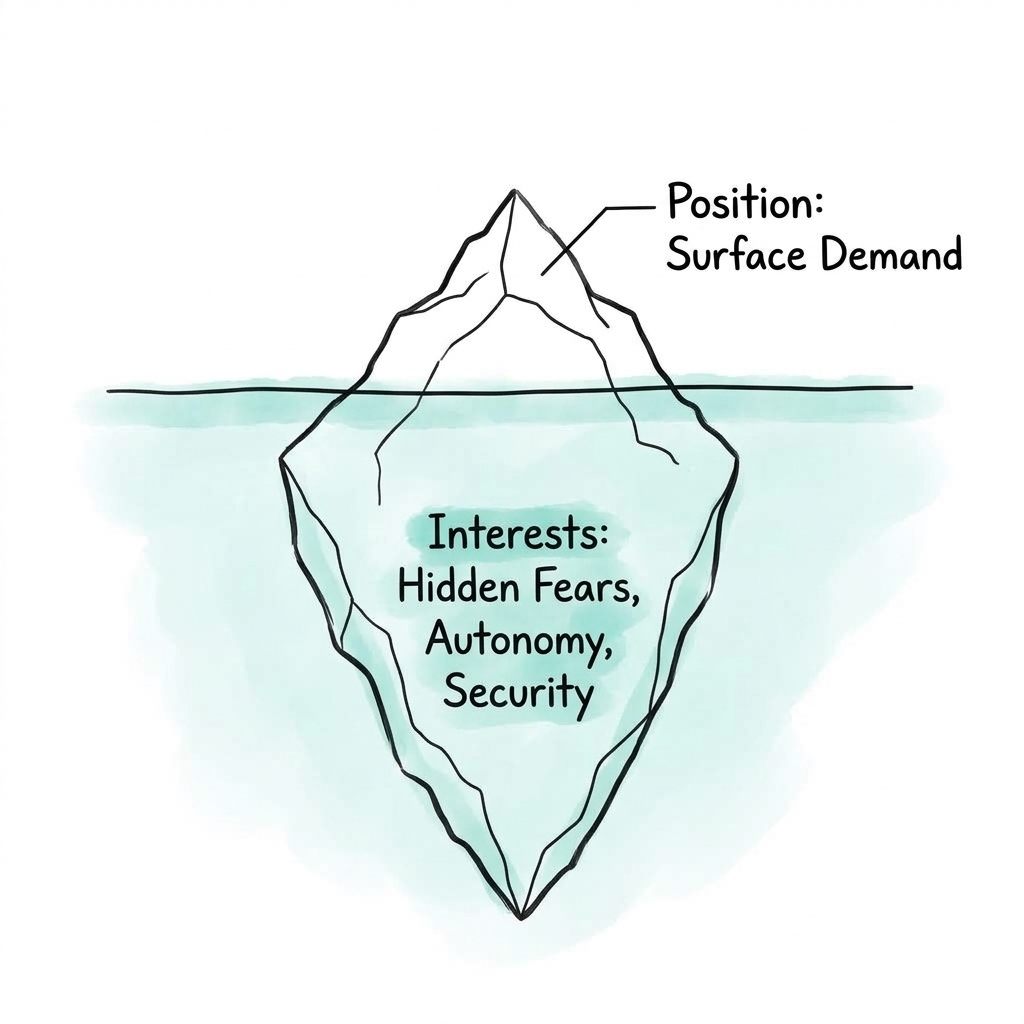
Imagine an upset client who snaps and says they refuse to pay the latest invoice until you redo the entire project.
If you treat that statement as a boxing match, you immediately cite contract clauses, billable hours, and legal threats. You have accepted their invitation to fight.
An emotional jujitsu pivot looks completely different. You let their threat land without panicking, and you treat their extreme demand as an awkward attempt to solve an unspoken problem.
Address the fear behind the invoice directly. You can ask, "It sounds like you feel this deliverable will fall short in front of your executive team. Given our technical constraints, how do you suggest we close that gap without missing the overall release date?"
This single move accomplishes three things at once. It acknowledges their anxiety, refuses to turn their anger into a personal duel, and gently invites them to sit on the same side of the table to solve a mutual constraint. You protect your boundaries without turning a professional disagreement into open warfare.
Looking for the missing bullet holes
Most people assume that arguing follows a straight line. They believe that doubling their volume or adding five more pieces of evidence will double their chances of convincing someone.
In practice, persuasion breaks down under pressure. Beyond a certain threshold, piling on more facts only hardens the other person's defensiveness.
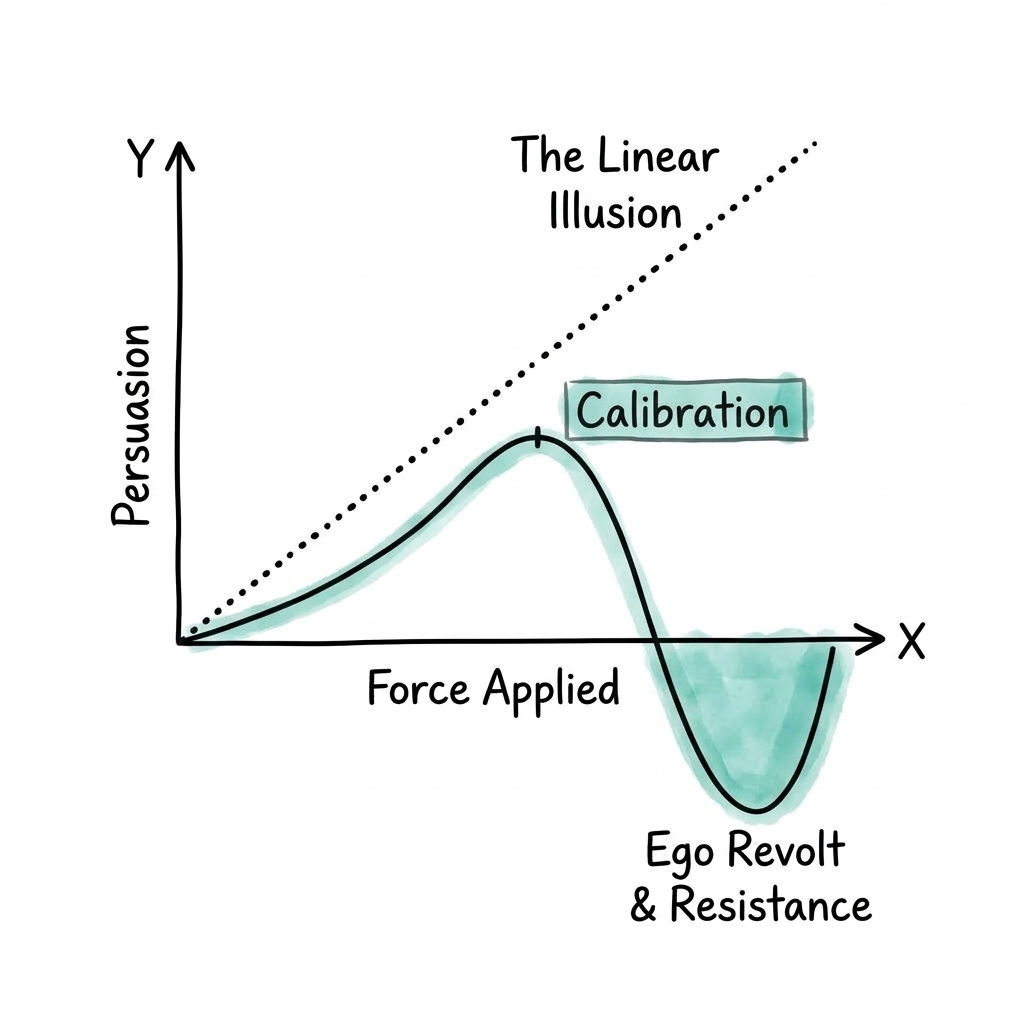
When an argument gets stuck, the stated issue is almost never the real issue.
During the Second World War, the Statistical Research Group in the United States examined bombers returning from combat missions. Bullet holes were clustered across the wings, fuselage, and tail gunner sections. Military officers initially wanted to reinforce armor on the wings, where the damage appeared heaviest.
Mathematician Abraham Wald reached the opposite conclusion. He pointed out that the armor needed to protect the areas without bullet holes, like the engines and the cockpit.
The military was falling for survivorship bias. Planes that took damage to the wings managed to fly back home. Planes hit in the engines plummeted.
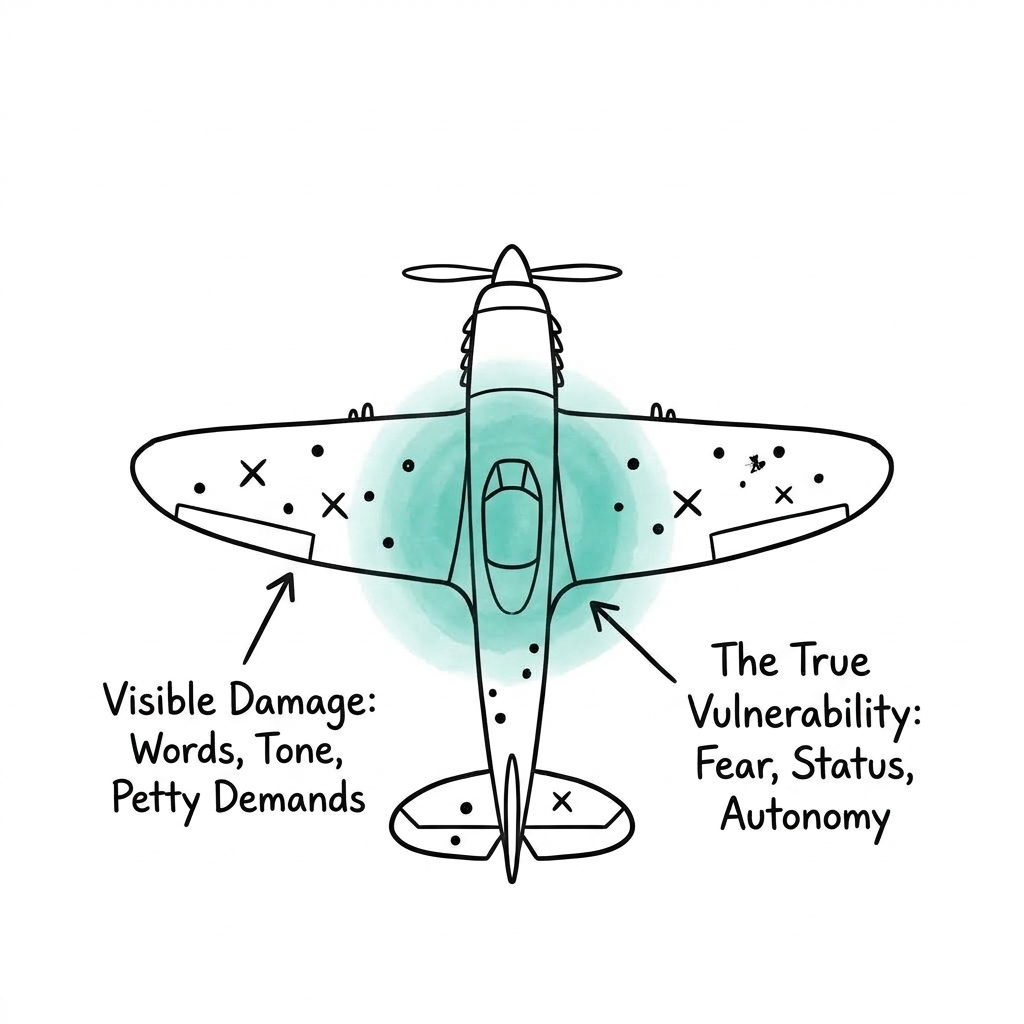
In human conflict, what people yell about is usually just the wings taking fire.
When a manager throws a tantrum over a slide layout or an awkward font, they are rarely upset about typography. They are usually terrified of looking disorganized in front of the board, or losing control over their team.
If you spend an hour defending the font size, you are reinforcing the wings while the plane goes down. When you address the unspoken vulnerability, such as their reputation, their autonomy, or their timeline, the surface drama almost always evaporates.
Adding a new variable to a deadlock
When two people are trapped arguing over a single variable, someone has to lose for the other to win.
If a negotiation is stuck entirely on price or a launch date, neither side can budge without feeling humiliated. The easiest way to unlock the room is to introduce an entirely new variable.
If a client cannot move on price, shift the conversation to payment schedules, delivery phases, or scope. You might ask whether they would be open to completing the planning phase now under the current budget, while scheduling the larger implementation for next quarter's financial cycle.
Adding another dimension turns an ego-driven tug-of-war into a flexible puzzle. Suddenly, both people have room to move without losing face.
Asking questions that disarm without pushing
Trying to control an aggressive room by making forceful statements almost always backfires. Assertions invite counter-arguments, while questions invite thought.
The trick is knowing which questions to ask.
Questions starting with "why" tend to sound like an interrogation. Asking someone why they made a mistake or why they fell behind on a deadline immediately puts them on trial. Their brain scrambles to defend their pride, and they reach for excuses or blame others.
If you substitute "why" with "how" or "what," the dynamic changes entirely.
When an unreasonable demand lands on your desk, you can simply ask how you are expected to accomplish it with your current resources.
This is one of the most effective maneuvers in difficult conversations. It hands the practical constraints directly to the other person and asks them to solve the equation. In a single sentence, they have to step out of attack mode and reckon with physical reality.
If someone is digging their heels in and refusing to engage, you can ask what happens if you cannot reach an agreement today. That forces both people to look past the heat of the moment and evaluate the realistic cost of walking away.
And when you suspect someone is agreeing just to get out of an uncomfortable room, do not settle for a quick yes. A polite yes is often just a smoke screen.
Instead, summarize their constraints, their worries, and their priorities so accurately that they look at you and say, "That's right."
When someone says those two words, their defensiveness vanishes. They feel seen, they drop their guard, and real problem-solving begins.
The three-beat sequence
When you are in the middle of a tense conversation, memorizing complex scripts is useless. Under stress, your working memory shrinks, and you will forget whatever bullet points you read online.
All you need to remember is a three-beat rhythm.
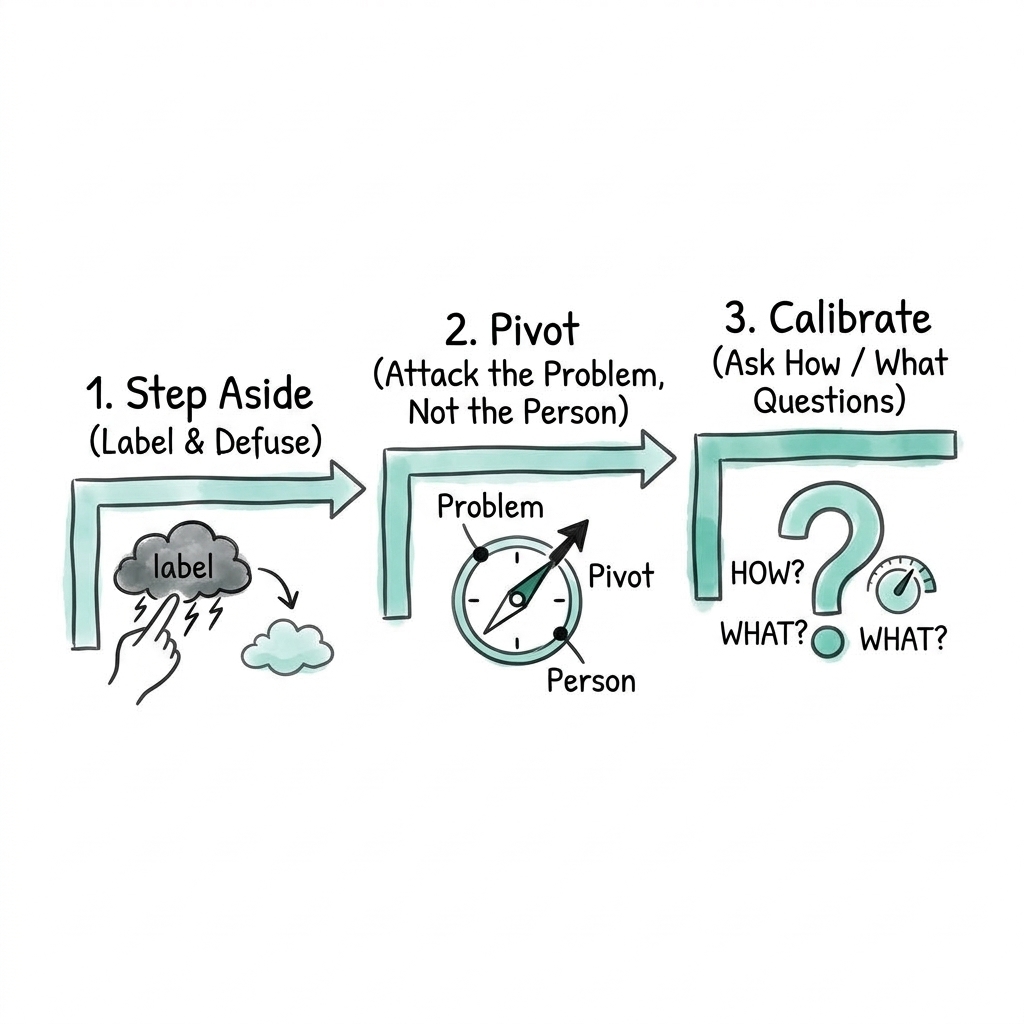
First, step aside and name their pressure. You pause, take a slow breath, and reflect the emotional temperature in the room without arguing. You might say that it sounds like they are worried the launch is slipping.
Second, pivot toward the mutual constraint. You validate the piece of reality they care about, and tie it to the outcome you both share. You confirm that if the delay is not addressed immediately, the whole release will suffer.
Third, calibrate with a question. You invite them to participate in the solution by asking how the timeline can be adjusted to protect their quality standards without blowing past the deadline.
In less than twenty seconds, you have absorbed the initial shock, reframed the disagreement around a shared goal, and invited them to help solve it.
The quiet strength of walking away calm
Shouting, trading insults, or losing your temper in an argument usually happens when you feel cornered.
When someone attacks you, your biology tells you to fight fire with fire. But meeting aggression with more aggression only traps you in the other person's storm. You become reactive, predictable, and easy to manipulate.
Real strength in a difficult conversation comes from emotional immunity. You win by keeping your composure, protecting your boundaries, and refusing to step into someone else's storm.
When you learn to step off the line of attack, look for the unspoken fear beneath the anger, and redirect hostile energy toward the real problem, conflict loses its sting.
You keep your self-respect, and you leave the room with your peace completely intact.